Welcome back to the TechNet Wire. In this issue:
- TechNet AI Policy Lead Liz O’Bagy writes about underappreciated, yet critical, AI policy work happening in Washington;
- The tech industry’s concerns with the potential for broad-based tariffs on essential tech hardware for U.S. innovation; and
- “Bits and Bytes” — announcements and other news from TechNet members.
Thought Cloud
TechNet AI Policy Lead Liz O’Bagy:
There’s a lot of frustration that Washington isn’t moving fast enough on AI safety, but I think we’re overlooking critical work happening in a federal agency that is far less headline-grabbing but equally as important as whatever may come out of the legislative branch.
The National Institute of Standards and Technology (NIST) has recently undertaken two efforts to address the fundamental question of how we evaluate AI and ensure it works well for people, and TechNet has weighed in with recommendations on both.
1. The “Zero Draft” for Public-Facing AI Documentation: Proposed standards for AI developers to explain their models’ capabilities, data characteristics, and risk factors in an accessible manner.
- This guidance has the potential to serve as the basis for a universal AI “instruction manual,” using common language to explain how AI models are built, how they work, and what they can do.
- We see this first draft as a useful starting point for demystifying AI and supporting effective risk management. With modest improvements to make it more practical and applicable globally — which we outlined in our comment letter — this guidance can go a long way toward fostering greater trust in responsible AI development and deployment.
2. The TEVV-Athlon Framework for Evaluating AI Systems: Proposed standards for testing, evaluation, verification, and validation (TEVV) of AI models.
- NIST’s TEVV framework seeks to establish credible ways to test whether systems perform as intended, identify where they fail, determine whether safeguards actually work, and reevaluate them as the technology evolves.
- In our comments to NIST on this framework, we encouraged the agency to preserve its flexible, risk-based foundation while providing clearer and more practical guidance on how organizations should design evaluations, interpret and report results, allocate responsibilities, test safeguards, and determine when reevaluation is necessary.
The bottom line: Congress may still be finding its way on this issue, but there is meaningful AI policy and standards work being done within the federal government.
Setting common rules of the road for evaluating increasingly capable systems is essential for staying ahead of the risks that AI can pose and ensuring people can benefit from the enormous opportunities this technology has to offer.
Policy Download
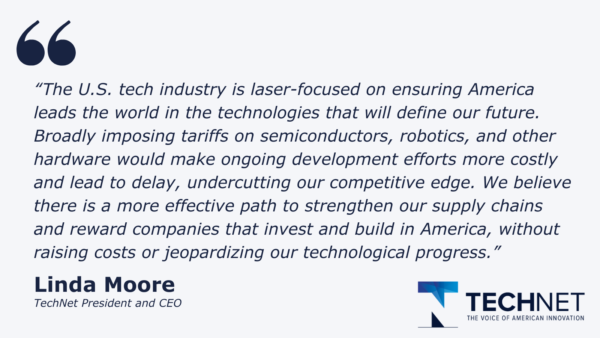
In case you missed it: The tech industry is cautioning the Trump Administration against imposing broad cost-raising tariffs on critical technology components that are essential for U.S. innovation, including semiconductors and robotics components.
TechNet sent this message to the President in a letter that was also signed by the leaders of the Computer & Communications Industry Association (CCIA), Consumer Technology Association (CTA), Information Technology Industry Council (ITI), and Software Industry Information Association (SIIA) — a coalition of advocacy groups that collectively represent hundreds of tech companies.
It comes as the President is considering whether to invoke his authority under Section 232 of the Trade Expansion Act to levy new duties on imported tech hardware.
The coalition warned that higher costs caused by tariffs would slow the development of the infrastructure that powers AI, undercutting the Administration’s goal of ensuring American dominance in the emerging technologies that will define our future.
The group also outlined an alternative approach to shoring up our supply chains while protecting our technological competitiveness. Its recommendations included pursuing policies that:
- Directly boost American production of technology hardware;
- Accelerate the approval of energy infrastructure projects;
- Strengthen domestic processing of critical minerals; and
- Encourage continued investment from trusted allies and partners.
TechNet Member Bits and Bytes
Reflection unveiled Beam, its first open-weight AI model built for coding, advanced reasoning, and multi-step tasks.
Instacart is partnering with UniteUs to expand access to nutritious food nationwide, giving payers, providers, and state and public sector organizations an easier way to deliver food-as-medicine programs at scale.
Instagram is helping students and parents stay informed through a new centralized hub for verified schools where school administrators can share quick updates with the community, students can access important reminders, and clubs and teams can communicate about upcoming events.
Thanks for reading,
The TechNet Communications Team
Subscribe to TechNet Wire
Receive TechNet Wire in your inbox.